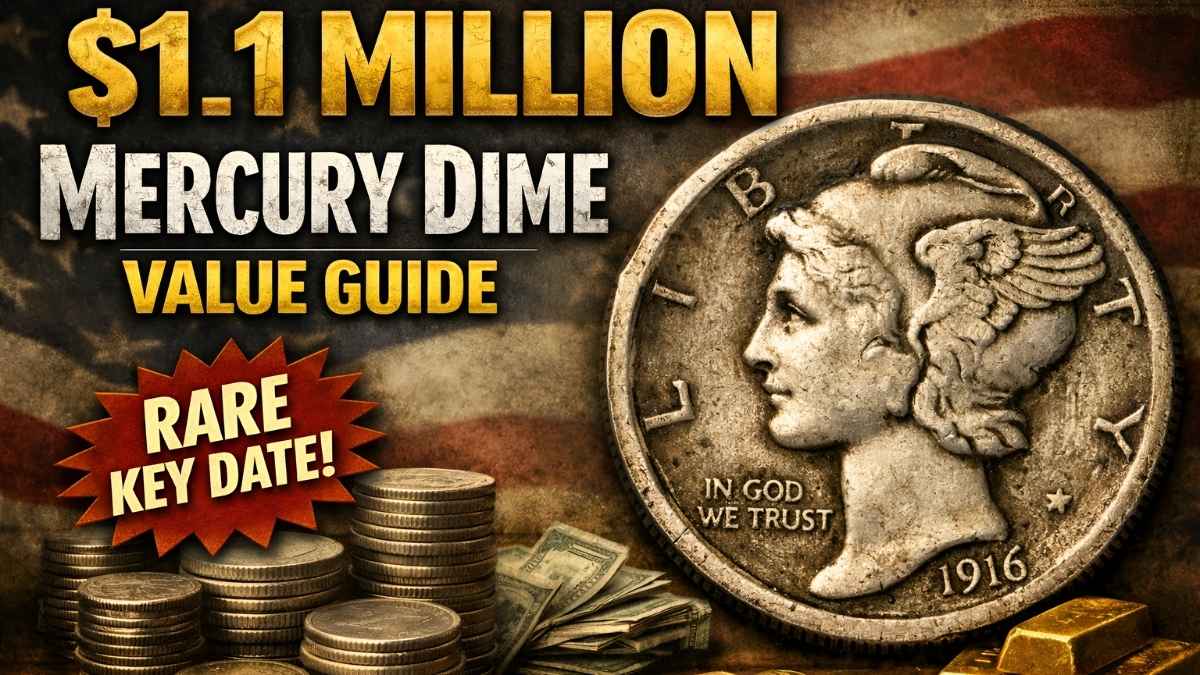
$1.1 Million Mercury Dime Value Guide: The Mercury dime, officially known as the Winged Liberty Head dime, was first issued in 1916 and remained in circulation until 1945. Designed by Adolph A. Weinman, the coin features Liberty wearing a winged cap, symbolizing freedom of thought. Collectors nicknamed it the “Mercury dime” because Liberty’s portrait resembled the Roman god Mercury. The reverse design shows a fasces, a bundle of rods with an axe, symbolizing unity and strength, accompanied by an olive branch representing peace. This combination of artistry and symbolism makes the Mercury dime one of the most admired coins in American numismatics.
Design Features That Define the Series
The obverse of the Mercury dime is celebrated for its elegance and detail. Liberty’s winged cap is finely engraved, and the overall composition reflects the artistic renaissance of early twentieth-century coinage. The reverse design is equally striking, with the fasces and olive branch conveying both resilience and harmony. These features make the coin not only a piece of currency but also a miniature work of art.
Mint Marks and Production Facilities
Mercury dimes were produced at several U.S. Mint facilities:
- Philadelphia (no mint mark)
- Denver (D)
- San Francisco (S)
Mint marks are located on the reverse, near the bottom left of the fasces. Coins from different mints vary in rarity, with certain years and mint marks commanding significant premiums. Collectors pay close attention to these details when evaluating value.
Mintage Numbers and Rarity
Mintage numbers play a critical role in determining rarity. Some years saw high production totals, making those coins common in circulation. Others had much lower mintages, which increases their scarcity and desirability. The 1916-D Mercury dime is one of the most famous rarities in the series, with only a small number struck, making it highly valuable today. Low mintage figures combined with historical significance drive collector demand.
Value of Circulated Coins
Most circulated Mercury dimes are worth modest amounts above their face value, especially for common years. However, condition matters greatly. Coins with heavy wear may only be worth a few dollars, while lightly circulated examples can attract higher prices. Even circulated coins hold historical significance and are popular among collectors who appreciate their artistry.

Value of Uncirculated and Proof Coins
Uncirculated Mercury dimes, often preserved in collections, can range in value from tens to hundreds of dollars depending on rarity and grade. Proof coins, struck in limited numbers, are especially prized for their sharp details and mirror-like finish. These coins often command significant premiums, with values reaching into the thousands for rare dates and high grades.
Error Coins and Their Premiums
Error coins add excitement to collecting. Mercury dimes may feature errors such as doubled dies, off-center strikes, or misaligned mint marks. These mistakes are rare and can significantly increase a coin’s value. Depending on the type and visibility of the error, values can range from hundreds to thousands of dollars. Error coins are highly sought after because they combine rarity with uniqueness.

The Story Behind the $1.1 Million Coin
The figure of $1.1 million attached to a Mercury dime reflects the extraordinary value that rare and unique specimens can achieve at auction. While most Mercury dimes are worth modest amounts, certain rare varieties, especially those in exceptional condition or with dramatic minting errors, can command staggering prices. The $1.1 million valuation highlights the fascination and speculation surrounding this iconic coin, showing how rarity and condition can elevate a dime into a numismatic treasure.
Condition and Grading Standards
Grading is essential in determining a coin’s value. The scale ranges from Poor (P-1) to Mint State (MS-70). For Mercury dimes:

- Circulated examples typically grade between G-4 and VF-20.
- Uncirculated coins may grade MS-60 to MS-65.
- Exceptional specimens can reach MS-67 or higher, commanding premium prices.
Professional grading services provide certification that enhances credibility and marketability, especially for coins with potential high value.
Collector Demand and Market Trends
The Mercury dime remains one of the most popular coins among collectors. Its historical significance, artistic design, and variations in rarity ensure steady demand. Market trends show that rare dates, mint marks, and high-grade examples continue to attract strong interest. Collectors often seek complete sets to capture the full history of the series, making the Mercury dime a cornerstone of many collections.

Building a Collection Around Mercury Dimes
For many collectors, the Mercury dime is a gateway into numismatics. It is affordable, historically significant, and visually distinctive. Building a collection around Mercury dimes allows enthusiasts to explore different mint marks, finishes, and error varieties. The series offers opportunities for both casual hobbyists and serious numismatists, with values ranging from a few dollars to millions for rare specimens.
Conclusion: The Enduring Appeal of the Mercury Dime
The Mercury dime is more than just a coin in circulation. It is a symbol of American artistry and history, representing freedom, unity, and peace. While most examples are worth modest amounts, rare varieties and exceptional specimens can command extraordinary premiums, sometimes reaching over a million dollars. The story of the $1.1 million Mercury dime underscores the enduring fascination with this coin and its place in numismatic heritage. Whether collected for its design, historical significance, or investment potential, the Mercury dime continues to inspire and captivate collectors around the world.