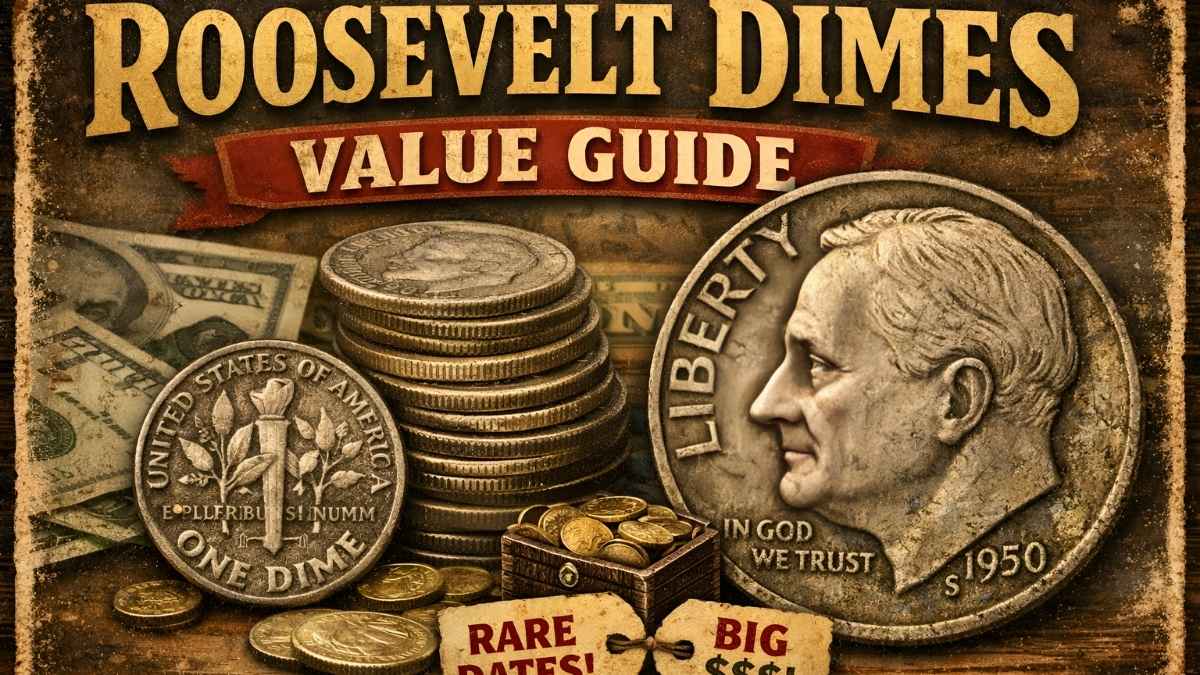
Roosevelt Dimes 2026 Value Guide: The Roosevelt Dime was first introduced in 1946 to honor President Franklin D. Roosevelt, who had passed away the previous year. Designed by John R. Sinnock, the coin features Roosevelt’s portrait on the obverse and a torch, olive branch, and oak branch on the reverse, symbolizing liberty, peace, and strength. Over the decades, the dime has become one of the most widely circulated coins in the United States, yet certain rare varieties and minting errors have transformed ordinary dimes into hidden collector treasures.
Common Versus Rare Examples
Most Roosevelt Dimes are common and worth only their face value. Circulated examples from the 1960s onward are plentiful, especially those made of copper-nickel after 1965. However, silver dimes minted before 1965 and rare error coins can command significant premiums. Collectors in 2026 continue to search for these hidden gems, knowing that even small coins can hold big money potential.

Key Dates That Drive Value
Some Roosevelt Dimes are especially valuable due to low mintages or unique characteristics. Collectors often seek:
- 1949-S, a low mintage coin that is scarce in high grades.
- 1955 Double Die Obverse, one of the most famous error varieties.
- 1968 No S Proof, a proof coin missing its mint mark.
- 1982 No P, a Philadelphia issue without the mint mark.
These coins have been known to sell for hundreds or even thousands of dollars depending on condition.
Error Coins Worth Big Money
Error coins are among the most exciting finds for collectors. Some of the most valuable Roosevelt Dime errors include:
- Double die strikes, where the date and lettering appear doubled.
- Off-center strikes, creating a visually unusual coin.
- Coins struck on the wrong planchet, such as a blank intended for another denomination.
- Proof coins with missing mint marks, which are rare and highly prized.
These coins are scarce and often discovered by chance, making them highly desirable in auctions.
Collector Secrets in 2026
Experienced collectors know that patience and careful searching are essential. Some strategies include:
- Searching rolls of dimes from banks, where older coins occasionally appear.
- Examining inherited collections, which may contain overlooked rarities.
- Attending coin shows and auctions to learn from experts and spot valuable pieces.
- Using magnification to check for subtle errors that can dramatically increase value.
The Importance of Coin Grading
Professional grading is crucial for determining the true value of Roosevelt Dimes. Coins are graded on a scale from Poor (P-1) to Mint State (MS-70). A rare coin in mint state condition can be worth exponentially more than the same coin in circulated condition. Collectors often send their coins to grading services to ensure authenticity and maximize resale value.
Market Trends in 2026
The coin market in 2026 shows strong demand for classic American coins, especially Roosevelt Dimes with historical significance. Online auctions and collector forums have made it easier than ever to buy and sell coins, increasing competition and driving up prices for rare varieties. Error coins and high-grade examples continue to set record prices, while common coins remain affordable for beginners.
Risks and Challenges for Collectors
While collecting Roosevelt Dimes can be rewarding, there are risks to consider:
- Counterfeit coins exist, especially for rare varieties like the 1968 No S Proof.
- Market values fluctuate, and not all coins maintain their peak prices.
- Inexperienced collectors may overpay without proper research.
- Storage and preservation are critical, as improper handling can reduce value.
Conclusion
The Roosevelt Dime remains one of the most beloved coins in American history. In 2026, collectors continue to seek out rare varieties and error coins that can be worth big money. Whether found in a bank roll, inherited from a family collection, or purchased at auction, these dimes remind us that even small coins can carry immense historical and financial significance.